Reading a Sutra by Moonlight: The Heart-Mind of Zen Study
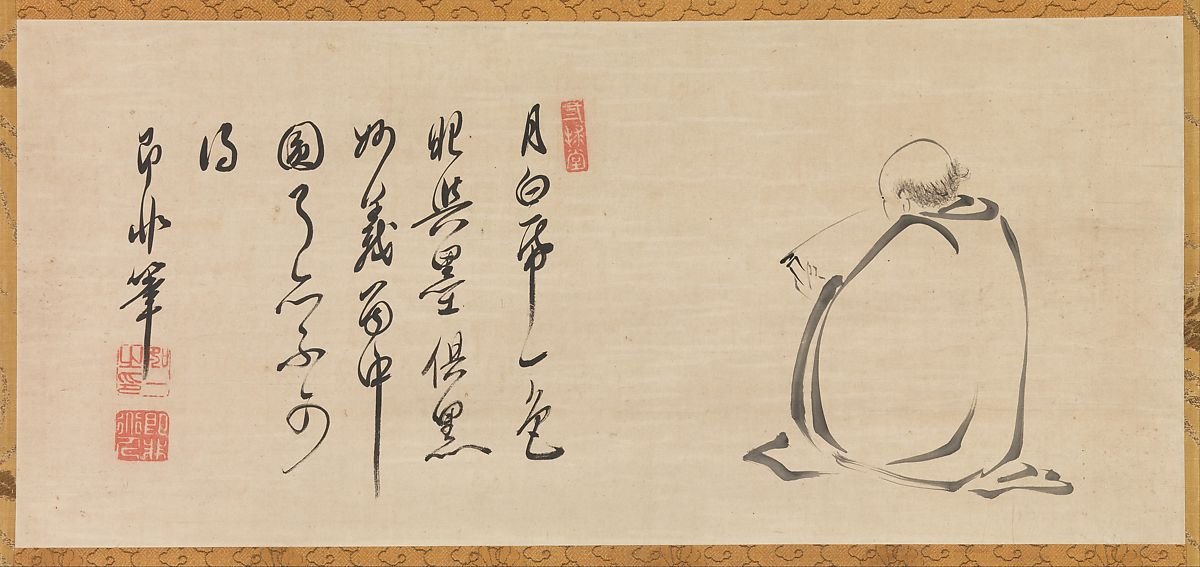
Sokuhi Nyoichi (Chinese: Jifei Ruyi) (1616-1671), Reading a Sutra By Moonlight, ink on paper, 10 13/16 x 23 7/8 in. in the collection of the Metropolitan Museum of New York, found here.
The painting above, Reading a Sutra by Moonlight, by Sokuhi Nyoichi, depicts a monk reading, turned in such a way that what he is looking at is also facing us. This speaks both to the quiet solitude and also to the shared experience of reading as an awakening activity. The translation of the calligraphy reads:
The moon and white paper are one color,
The pupil of the eye and the ink are both black.
The marvelous meaning lodged in the circle
Is beyond comprehension.
The pupil of the painter’s eye and the pupils of our own eyes are in the same spot before the painting, even though by conventional standards we are from different places and times. And what is described is that the material world, the poetry of metaphor and the geometry of symbols, and our own bodies are undivided.
It has been my experience that profound experiences such as the one described above are possible in reading a text, and also that one can develop a taste for it. And that these are two very different things - having a taste for something is not actually embodying it.
Sometimes we read a sutra in the moonlight, and sometimes we do not - in our Zen way how do we understand textual study as practice, actually? What is worth describing there that can help us to understand ourselves on this path?
I believe that it is with a compassionate understanding toward this situation that Dogen writes that “when Self turns the Law Self is strong and the Law is weak. In the reverse case the Law is strong and the Self is weak.”(1) I find in these words encouragement and equanimity toward the process of study.
One way to relate to this question of textual study as practice is to acknowledge that many Zen practitioners are in study groups, meeting regularly to study the same body of texts for years on end as people come and go. Like the zendo schedule, the regular meeting is a part of the experience. It’s been my experience that when there is a scheduled gathering to read together without explicit objectives, as in a class - to simply show up and be present for each other and present for the text - study invites something more like a conditioning than a knowledge. Here is how one study group described the effects of the process:
We have found that studying Dogen together is very rich, not only for what Dogen has to say but most importantly how our own insights jump into life and flourish in each other’s speech. What Dogen has amplified for us is a playful confidence in describing zazen and our community life together, and we have found in these gatherings the strong encouragement to explore it and to express it together. (2)
This expression happened to occur in a monastic setting where there was a strong zazen schedule and a group of people who had chosen to live in community with shared intentions to practice zazen. More noteworthy is that study groups exist in sanghas all over the world that are not in a monastic setting, and are generated from a shared dedication to zazen as formal practice.
No matter where one is, it is not always the case that study has this feeling of leaping from and into life. Because study is more directly engaged with what we call the mind - because it discriminates, acquires something we call “knowledge” and in the Buddhist tradition is understood to bind us in a limiting way - it has its own obstacles that other activities, such as chanting, for example, does not.
In his teachings on beginners mind, Suzuki Roshi spoke of the demand to know as a problem. As someone who has lived an academic life, I can say that sometimes there is an avaricious hoarding of knowledge, building a flimsy barrier to confusion. And sometimes there is pride in conceptual knowledge and the wielding about of ideas. Each of these at their worst carries no small whiff of arrogance. Because study can encourage self-conceit it is frequently discouraged as a worthy practice, and for good reason. However it is also true that in good measure each of these things can be of some benefit - such as a devotional hunger and a trust in that hunger.
How can the effort of study transform us? I find this process of study to be expressed poignantly in the poem of an academic who, differently expressed but in relation to the poem above, has demonstrated how words and embodiment move beyond what is simply inside and what is outside. Here is a verse by Denise Riley, entitled Maybe, Maybe Not:
When I was a child I spoke as a thrush,
I thought as a clod,
I understood as a stone,
but when I became a man put away
plain things for lustrous,
yet to this day squat under hooves
for kindness where fetlocks stream with mud -
shall I never get it clear, down in the soily waters. (3)
The verse begins with the humble and true expression of the plain, like an offering of dirt in a child’s hands. As we grow older there is the inevitable discriminating mind that puts down one thing for another more desirable one. There is at the same time a profoundly transformative humility - a gift - that can be running beneath the intelligence we seek, and luckily for us that Buddhist teachings are there to reveal. It is in having seen one’s own confusion that there is an appropriate humility of insight. Squatting under hooves for kindness is not an abject humility - there is here deep awareness, the warmth of dissolution, a feeling of views dropping away, of thusness and of compassion.
In a 1970 dharma talk on the functioning of study Shunryu Suzuki said, “What we should do here is develop our study from the bottom of your heart. That is the most important point. You must be faithful to yourself.” (4) We and you - they are not separate, dropping down into the gravity of human form. I understand Shunryu Suzuki to be saying be faithful to yourself, develop a taste for your own being. Drop down into the bottom of your heart where intention becomes resolve and we will do this together.
Considered in this way, when Dogen writes that “when Self turns the Law Self is strong and the Law is weak. In the reverse case the Law is strong and the Self is weak,” a taste for the dharma that turns is already in the mouth of the self that is turning the dharma. In the resolve that comes from the bottom of our heart, these two things are not as separate as one might think.
By Catherine Spaeth
***
1. Eihei Dogen, Gakudo Yojinshu, Yuho Yokoi, trans., in Gien Inoue, A Blueprint of Enlightenment: A Contemporary Commentary on Dogen Zenji’s Gakudo Yojinshu, Daigaku Rumme and Keiko Ohmae, trans., Temple Ground Press c. 2020, p. 47.
2. This is an excerpt from guidelines that were written for the Dogen Study Group at Tassajara, 2005.
3. Denise Riley, “Maybe, Maybe Not” in Say Something Back, New York review of Books, c. 2020.
4. Shunryu Suzuki Transcript, “we try to control or restrict our activity,” Tuesday Evening, May 5, 1970, City Center, San Francisco found here: cuke.com